Research Article | | Peer-Reviewed

Study on the Development of Cross-border E-commerce by the Policy Trials of the Free Trade Zones (FTZ)

Published in Economics (Volume 13, Issue 4)
Received: 1 October 2024     Accepted: 1 November 2024     Published: 14 November 2024
Views:       Downloads:
Abstract

The Pilot Free Trade Zone is a milestone policy for opening up the foreign economy, and plays an important role under the policy orientation of ‘early and pilot implementation’ in China. 2023 will mark the 10th anniversary of the construction of the Pilot Free Trade Zone in Shanghai, and the new development pattern is based on the domestic macro-cycle as the main body, and the domestic and international double-cycle is mutually promoted, and cross-border e-commerce is just an important connection link relying on Internet technology and the emerging trade mode. Cross-border e-commerce, as an emerging trade mode relying on Internet technology, is an important link between the domestic and international double cycle. Exploring the path of enhancement of cross-border e-commerce development by the policy experiment of the Pilot Free Trade Zone can help to build a new development pattern in which the domestic and international double cycles promote each other, and provide a basis for deepening the policy in the future. Under the guidance of trade cost theory, government reengineering theory and cooperation theory, this paper draws the following conclusions, and the FTZ has reduced the trade cost of enterprises and further stimulated the vitality of cross-border e-commerce by continuously optimising the tax policy and simplifying the customs clearance procedures. In the future, it is necessary to aim for high-quality green development, identify strategic positioning, and give full play to regional characteristics, and at the same time, refine and improve the rules and standards for the development of digital trade and implement them fairly and equitably, so as to better promote cross-border e-commerce as well as the sustainable development of the economy as a whole.

Published in Economics (Volume 13, Issue 4)
DOI 10.11648/j.eco.20241304.12
Page(s) 100-105
Creative Commons

This is an Open Access article, distributed under the terms of the Creative Commons Attribution 4.0 International License (http://creativecommons.org/licenses/by/4.0/), which permits unrestricted use, distribution and reproduction in any medium or format, provided the original work is properly cited.

Copyright

Copyright © The Author(s), 2024. Published by Science Publishing Group

Keywords

Free Trade Zone, Cross-border E-commerce, Digital Trade

1. Introduction
1.1. Meaning of FTA
The concept of FTAs can be analysed from two different perspectives. From the perspective of international cooperation, it refers to the implementation of preferential policies, such as tariff reductions and exemptions, between multiple countries or regions in order to reach the goal of trade liberalisation through the signing of trade agreements, with the aim of breaking down trade barriers between them and achieving complementary and synergistic economic development. The areas covered by tariff reductions and exemptions under such a cooperation framework are commonly referred to as free trade agreement areas (FTAs).
From the perspective of special domestic policy zones, free trade zones refer to specific areas within a country's territory that enjoy unique economic policies and management regimes, with exemption from regular customs controls as one of their core features. Such free trade zones, often referred to as pilot free trade zones (FTZs), are strategic platforms set up by the state to deepen opening up to the outside world, attract foreign investment, and promote the transformation and upgrading of industrial structure. The research object of this paper mainly focuses on the latter, Free Trade Zones (FTZs).
1.2. Development History of FTZ
1.2.1. Pilot Phase (2013-2014)
In September 2013, the State Council issued the Circular on the Overall Programme of the China (Shanghai) Pilot Free Trade Zone. Shanghai took the lead in becoming China's first Pilot Free Trade Zone. The implementation area of the Shanghai Pilot Free Trade Zone is approximately 29 square kilometres, covered by the Waigaoqiao Free Trade Zone, Waigaoqiao Bonded Logistics Park, Yangshan Bonded Port Zone and Shanghai Pudong Airport Comprehensive Bonded Zone. The Shanghai Pilot Free Trade Zone has become a testing ground for financial and trade reforms, with core highlights including the introduction of the "Negative List" management model and breakthroughs in cross-border capital flows and customs facilitation.
1.2.2. Coastal Expansion Phase (2015-2016)
The first batch of multi-region FTZ were established, in which China's pilot FTZ expanded from a single region to more developed coastal areas. The FTZ in Guangdong, Tianjin and Fujian cover important cities such as Guangzhou, Shenzhen, Zhuhai, Tianjin, Xiamen and Fuzhou respectively. These FTZ have been given mandates that match their respective economic structures and locational advantages.
1.2.3. Diversity Exploration Phase (2017-2022)
The gradual expansion of the FTZ from the coast to the central and western regions, including Shaanxi, Sichuan and Chongqing, marks the expansion of the FTZ from the coastal economic belt to the inland hinterland. These regions are important nodes of the "Belt and Road" strategy. The establishment of the Hainan FTZ is unique in that it is China's first island-wide FTZ and an important policy experiment for the country's economic development in the south. Hainan FTZ aims not only to promote trade facilitation and financial innovation, but also to create a high-level international business environment and become the pilot test area for China's free trade port. It is seen as an important step in the construction of a future Chinese free trade port, focusing on exploring liberalised investment policies, tax incentives, international shipping and other institutional innovations.
1.2.4. A new Phase of Deepening Exploration (2023-present)
The Xinjiang FTZ focuses on promoting border trade, energy cooperation and industry chain interconnection with Central Asian countries, further leveraging its role as a strategic hub on the Eurasian Continental Bridge.
Policy innovation: Through the superimposed effects of border economic cooperation zones and bonded zones, Xinjiang FTZ is committed to promoting industrial upgrading and economic integration in the border areas, and has become an important test area for the inland open economy.
By the end of 2023, China has successfully set up 21 pilot free trade zones, which in a way have constructed a reform and opening-up innovation model covering the whole world, with a cross-regional layout covering the east, west, south, north and central regions. Such a superior geographic state of establishment and distribution, together with its special economic system and way of conducting business, will undoubtedly give a strong impetus to China's opening up to the outside world at a higher quality and level, and inject new vitality into China's realisation of modernisation in the new era.
Table 1. China Free Trade Zone Establishment Date and Location.

Est. Date

Province

Pilot Cities

Planned Area (km²)

Sep-13

Shanghai

Shanghai

120.7

Apr-15

Guangdong

Guangzhou, Shenzhen, Zhuhai

116.2

Apr-15

Fujian

Fuzhou, Xiamen, Pingtan

118.04

Apr-15

Tianjin

Tianjin

119.9

Mar-17

Liaoning

Dalian, Shenyang, Yingkou

119.89

Mar-17

Henan

Zhengzhou, Kaifeng, Luoyang

119.77

Mar-17

Hubei

Wuhan, Xiangyang, Yichang

120

Mar-17

Chongqing

Liangjiang, Xiyong, Guoyuan Port

119.98

Mar-17

Sichuan

Chengdu Tianfu New Area, Qingbaijiang Railway Port, Southern Sichuan Port

119.99

Mar-17

Shaanxi

Xi'an International Port Area, Yangling Demonstration Zone

119.97

Mar-17

Zhejiang

Zhoushan, Hangzhou, Ningbo

119.95

Oct-18

Hainan

Haikou, Sanya

Entire Island

Aug-19

Shandong

Jinan, Qingdao, Yantai

119.98

Aug-19

Jiangsu

Nanjing, Suzhou, Lianyungang

119.97

Aug-19

Guangxi

Nanning, Qinzhou Port, Chongzuo

119.97

Aug-19

Hebei

Xiong'an, Zhengding, Caofeidian, Daxing Airport

119.97

Aug-19

Yunnan

Kunming, Honghe, Dehong

119.86

Aug-19

Heilongjiang

Harbin, Heihe, Suifenhe

119.85

Sep-20

Beijing

Beijing

119.68

Sep-20

Hunan

Changsha, Yueyang, Chenzhou

119.76

Oct-23

Xinjiang

Urumqi, Kashgar, Khorgos

179.66

1.3. Development History of Cross-Bordere-Commerce
In 1999, with the popularity of the Internet, e-commerce gradually emerged, but cross-border e-commerce is still in the exploration stage. China's foreign trade relies on traditional offline channels, cross-border e-commerce has not yet formed a large-scale industry. 2008 with the acceleration of globalisation, cross-border e-commerce began to appear B2C, the phenomenon of shopping on behalf of the Amoy and the emergence of the state began to notice this phenomenon and give, in 2013-2014, the state launched the pilot zone of e-commerce, the pilot zone of free trade, and a series of policies, and due to the improvement of logistics technology as well, cross-border e-commerce has entered an explosive period. Improvement and, cross-border e-commerce into the explosion period.
The cross-border e-commerce industry entered the period of brand going overseas wave in 2020. The distinctive feature of this phase is the gradual increase in the global influence of Chinese brands. Against the backdrop of globalisation, more and more Chinese enterprises are no longer satisfied with mere export of goods, but are building their own brands through cross-border e-commerce and enhancing their brand image and market share globally. This process has been made possible by the upgrading of platforms, the extensive use of digital marketing tools and the optimisation of cross-border logistics. Especially during the epidemic, global demand for e-commerce soared and cross-border e-commerce became one of the most important forms of international trade. Chinese companies seized this opportunity, not only exporting goods through cross-border e-commerce platforms, but also actively building overseas warehouses and implementing localised operation strategies so as to better meet the needs of international consumers. In addition, innovative cross-border e-commerce models such as live streaming with goods, social e-commerce and other emerging forms have also provided new channels for Chinese brands to go overseas. These changes reflect that China's cross-border e-commerce has upgraded from simple commodity flow to a new stage of global brand operation and supply chain management.
1.4. Significance of China's Pilot Free Trade Zones
Under the situation of weak global economic recovery and cold international trade and investment, the Pilot Free Trade Zones (FTZ) have released warmth by continuously expanding high-level opening up.2022, the 21 FTZ, with less than four-thousandths of the country's total land area, accounted for 17.8 per cent of the country's import/export trade and 18.1 per cent of the country's FDI.2023, in the first half of the year, they further increased to 18.4 per cent and 18.6 per cent, respectively. This gives a full picture of the important role of the Pilot Free Trade Zones in economic development.
Pilot free trade zones are like testing grounds for new policies, where specific geographical procedures allow policy and institutional innovations to be tried out without having to be immediately extended to the whole country, so that the effects of new policies can be observed and evaluated, and then extended if there are favourable results. This is in line with the principles of "trial and error mechanism" and "progressive planning" in public administration. At the same time, the Pilot Free Trade Zone can provide importing and exporting enterprises with a variety of convenient conditions, such as simplified customs clearance procedures for goods and a more favourable business environment, thus attracting more enterprises to move into the zone and promoting the economic prosperity of the region. The concept of one-stop service, minimisation of approvals and simplification of procedures promotes the enhancement of administrative services and innovation in working methods. The concrete implementation of "one-stop service", such as one-stop declaration and one-stop enquiry, greatly facilitates the operation of investors and businessmen, saving time and cost.
Institutional innovation to promote the high-quality development of industry is the starting point for the construction of Pilot Free Trade Zones, Pilot Free Trade Zones can not be separated from the general direction of promoting development and adjusting the structure, cross-border e-commerce and other new business models can be benefited from a lot of them, with greater efforts to plan and promote the high-quality development of Pilot Free Trade Zones, the development of cross-border e-commerce has significantly increased the technological complexity of the manufacturing industry in the region's exports (Wen Yang 2023), which has provided more opportunities for China's manufacturing's position in the middle and high end of the global value chain provides more opportunities. For example, in the Shenzhen Free Trade Zone, convenient customs clearance process arrangements, lower logistics costs and more frequent flights provide tangible advantages for the development of cross-border e-commerce, which in turn indirectly promotes the development of air cargo, on which cross-border e-commerce relies, and makes the logistics more rapid and efficient. At the same time, the speeding up of air cargo will greatly promote the efficiency of cross-border e-commerce logistics, and also allow trade and business entities to enjoy tangible benefits. In the longer term, it will be conducive to the growth of the social and economic structure to the tertiary industry, so that the pillars of the secondary industry have the corresponding policy dividends.
2. Background and Significance of the Study
2.1. Policy Context
As the fit of global trade deepens, China embarks on a period of deepening reform and opening up, expanding opening up to the outside world enters a deep water zone, upgrading industrial structure, and facilitating the trade process requires that the Pilot Free Trade Zones come out in response to the times. As one of the centres of China's economy, Shanghai has been exploring more open policy mechanisms, and taking the lead in establishing a Pilot Free Trade Zone in Shanghai in 2013 was a proper response to changes in domestic and international economic forms.
"System innovation as the core, scalable and replicable as the basic requirements" is the guidelines of the pilot free trade zone, up to now, the country has reached 67.7% of the pilot rate, respectively, through six batches of 21 provinces and cities across the country pilot. 2023 September, Shanghai Pilot Free Trade Zone ushered in the much-anticipated tenth anniversary of the commemorative node. This pilot zone is not only a forward-looking policy measure that expresses the reform and opening-up actively promoted in the new era, but also an epoch-making major milestone in the course of deepening reform and expanding opening-up in China. The setting up of the zone has undoubtedly accelerated the pace of the construction of China's socialist market economy, pushed forward the rapid development of China's economy, and largely influenced and shaped the economic outlook of China in the new era. The report of the 20th Party Congress proposes the implementation of the strategy of upgrading the Pilot Free Trade Zone (FTZ), and it is worth thinking about how to continue to walk the future path of the FTZ in the future.
2.2. Status of Cross-Border E-commerce Development
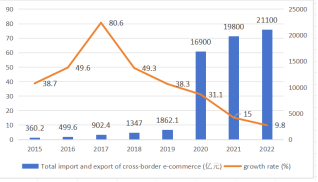
The level of cross-border e-commerce cross-border development of a country is closely related to the level of its foreign trade, while the development of cross-border e-commerce is also closely related to the local industrial structure and the innovation ability of enterprises. Cross-border e-commerce has gradually become an important part of China's foreign trade, in the context of economic globalisation and the global value chain of the Internet, cross-border e-commerce is the world's countries competing for the development and the pursuit of occupying a place in the trade strategy of the heights , to explore to promote the influence of cross-border e-commerce high-quality development factors is to keep abreast of the times of the question.
Figure 1. China's Total Import and Export of Cross-border E-commerce and Growth Rate, 2015-2022.
Cross-border e-commerce is a way of cross-border trade exists at the core of the end of the single transaction to enjoy lower costs, higher efficiency, but it itself requires a large upfront investment to form the basis of trade. In the cost structure of cross-border e-commerce, logistics costs and procurement costs account for 20%-25% respectively. In recent years, under the dual impetus of upgrading cross-border export e-commerce products and overseas consumers' demand for ultimate delivery experience, China's cross-border e-commerce export logistics overseas warehouse mode has developed rapidly, and the number of overseas warehouses has been growing rapidly in major countries around the world. Cross-border e-commerce platforms realise e-commerce order fulfilment and storage functions through the use of third-party overseas warehouses, self-owned overseas warehouses and other warehousing resources, reducing consumers' poor perception of headway and intermediate cross-country transport long lead times, and saving the cost of distribution of bulky and heavy cargoes, and enhancing the conversion rate of product sales, as well as facilitating sellers' active participation in the competition in overseas markets. Therefore, more and more e-commerce platforms and brands are beginning to layout overseas warehouse, such as Cainiao self-built overseas warehouse service speed sell pass platform, but also attracted more third-party cross-border logistics companies to enter the overseas warehouse track.
At present, the major cross-border e-commerce platforms basically adopt the mode of "cross-border direct shipping + overseas warehouse" for transport fulfilment. According to the company's official website, the official Rookie warehouse and third-party overseas warehouses of Speedway cover 22 countries in Europe and the U.S. SHEIN's fulfilment system consists of domestic warehouses and overseas transit warehouses, TikTok Shop's overseas warehouses cover the U.K. and Southeast Asian countries, Temu only adopts cross-border direct dispatch service in domestic warehouses, and its overseas warehouses are in the process of preparation, and the overseas warehouses of Lazada are mainly deployed in Southeast Asian countries. Cross-border direct shipping and overseas warehouses are mutually irreplaceable cross-border fulfilment modes.
3. Conclusions
Pilot free trade zones are characterised by early and pilot implementation. Nowadays, mature experiences in single pilot zones, such as the "liberalisation of the first line and control of the second line" supervisory system, and the "declaration and inspection after entering the zone first" customs clearance method should be further promoted, so as to push forward the deepening of the process of administrative streamlining, financial internationalisation, investment liberalisation and trade facilitation . The Pilot FTZ is the central government's response to local governments. The Pilot Free Trade Zone is a decentralisation of the local economy by the central government, and we not only need to pay attention to the immediate economic performance, but also avoid the trap of over-emphasising the short-term economic gains that the local economy needs to watch out for. Pilot free trade zones should follow the path of long-term economic growth, high-quality development and green development.
Identifying its own characteristics and strengthening regional advantages. Combined with the State Council issued a number of measures to promote the reform and innovation of trade and investment facilitation in pilot free trade zones, there are a total of nineteen major directions, the existing free trade zones to find the positioning of the eastern region FTZ and the coastal areas of the FTZ, the internal FTZs should be different regional characteristics of the development of the path. At present, some of the pilot free trade zones have different strategic objectives and positioning according to their own regional characteristics. For example, Guangdong Pilot FTZ takes the construction of Guangdong-Hong Kong-Macao deep cooperation demonstration zone as its mission, and focuses on the general policy of relying on Hong Kong and Macao, serving the mainland and facing the world ; strengthening Fujian-Taiwan co-operation has become a prominent feature of Fujian Pilot FTZ; and high-quality development of the marine economy is the differentiated exploration task of Shandong Pilot FTZ. Then the FTZ in economically underdeveloped areas should focus on the development of advanced manufacturing industry as the leading industry, and actively introduce foreign high-quality capital, advanced science and technology and production management concepts to drive the development of the local economy. In addition through the existing pilot free trade zone planning area collated development, in addition to Hainan for the whole island pilot policy, the rest of the cities and municipalities to declare the pilot free trade zone area are between about 120 square kilometres, however, the provinces of the jurisdiction area is the size of the different, almost always the area of the pilot free trade zone in the future should be a place of concern in the future, in the future, in certain areas should be piloting a larger range of experiments.
Sound rules and standards for the development of digital trade. Cross-border e-commerce is different from the traditional trade model, relying on Internet technology, and has higher requirements for enterprises to update and iterate their technology. The economic growth promotion effect of the Shanghai and Guangdong FTZ is obvious, as demonstrated by the promotion effect on the tertiary industry. The government should improve the rules and standards for the development of digital trade, and endeavour to innovate policies on foreign exchange management and financial leasing, aiming to create more convenient conditions for the development of cross-border e-commerce, and to promote the high-quality development of new forms of foreign trade.
Funding
This work is supported by 2024 Graduate Research and Innovation Programme (Grant No. 2024YJSCS003)”.
Data Availability Statement
The data that support the findings of this study can be found at: http://www.customs.gov.cn/
Conflicts of Interest
The authors declare no conflicts of interest.
References
[1] Auboin, Marc, Robert Koopman, and Ankai Xu. Trade and Innovation Policies: Coexistence and Spillovers [J]. Journal of Policy Modeling, 2021, 43(4): 844-872.
[2] CAI J, XIN K, ZHOU Y. A Dynamic Panel Data Approach and Hcw's Method: Assessing The Effect of China (Shanghai) Free Trade Zone on Local GDP [J]. Journal of Management Science and Engineering, 2021, 6(3): 249-267.
[3] Brunet-Jailly E. Cross-border cooperation: a global overview [J]. Alternatives, 2022, 47(1): 3-17.
[4] JIAN J, LV L, WAN L. Exploring Consumer Purchase Intention in Cross-Border e-Commerce: Evidence from "Belt and road" Countries [J]. Asia Pacific Journal of Marketing and Logistics, 2022, Ahead-of-Print (Ahead-of-Print).
[5] Bao, Te, et al. "Trade liberalisation and trade and capital flows: Evidence from China pilot free trade zones." The World Economy 46.5(2023): 1408-1422.
[6] Chen L, Wei Q, Fu Q, et al. Spatiotemporal evolution analysis of habitat quality under high-speed urbanization: A case study of urban core area of China Lin-Gang Free Trade Zone (2002–2019) [J]. Land, 2021, 10(2): 167.
[7] Han, Bing, et al. The role of cross-border E-commerce on the export of goods and services. Electronic Commerce Research (2024): 1-18.
[8] Zhang L, Xu M, Chen H, et al. Globalization, green economy and environmental challenges: State of the art review for practical implications. Front [J]. Financial and Trade Globalization, Greener Technologies and Energy Transition, 2023, 16648714: 133.
[9] Chang Y, Iakovou E, Shi W. Blockchain in global supply chains and cross border trade: a critical synthesis of the state-of-the-art, challenges and opportunities [J]. International Journal of Production Research, 2020, 58(7): 2082-2099.
[10] Cheng H, Zhang Y I, Li H. Effects of free trade zone policy on China’s income disparity [J]. The Singapore Economic Review, 2022, 67(02): 709-732.
[11] Hendricks S, Mwapwele S D. A systematic literature review on the factors influencing e-commerce adoption in developing countries [J]. Data and Information Management, 2024, 8(1): 100045.
[12] Houssam N, Ibrahiem D M, Sucharita S, et al. Assessing the role of green economy on sustainable development in developing countries [J]. Heliyon, 2023, 9(6).
[13] Jain V, Malviya B, Arya S. An overview of electronic commerce (e-Commerce) [J]. The journal of contemporary issues in business and government, 2021, 27(3): 665-670.
[14] Gawusu S, Zhang X, Ahmed A, et al. Renewable energy sources from the perspective of blockchain integration: From theory to application [J]. Sustainable Energy Technologies and Assessments, 2022, 52: 102108.
[15] Tian X, Zhu J, Zhao X, et al. Improving operational efficiency through blockchain: evidence from a field experiment in cross-border trade [J]. Production Planning & Control, 2024, 35(9): 1009-1024.
Cite This Article
  • APA Style

    Zhai, J. (2024). Study on the Development of Cross-border E-commerce by the Policy Trials of the Free Trade Zones (FTZ). Economics, 13(4), 100-105. https://doi.org/10.11648/j.eco.20241304.12

    Copy | Download

    ACS Style

    Zhai, J. Study on the Development of Cross-border E-commerce by the Policy Trials of the Free Trade Zones (FTZ). Economics. 2024, 13(4), 100-105. doi: 10.11648/j.eco.20241304.12

    Copy | Download

    AMA Style

    Zhai J. Study on the Development of Cross-border E-commerce by the Policy Trials of the Free Trade Zones (FTZ). Economics. 2024;13(4):100-105. doi: 10.11648/j.eco.20241304.12

    Copy | Download

  • @article{10.11648/j.eco.20241304.12,
      author = {Jiayin Zhai},
      title = {Study on the Development of Cross-border E-commerce by the Policy Trials of the Free Trade Zones (FTZ) 
    },
      journal = {Economics},
      volume = {13},
      number = {4},
      pages = {100-105},
      doi = {10.11648/j.eco.20241304.12},
      url = {https://doi.org/10.11648/j.eco.20241304.12},
      eprint = {https://article.sciencepublishinggroup.com/pdf/10.11648.j.eco.20241304.12},
      abstract = {The Pilot Free Trade Zone is a milestone policy for opening up the foreign economy, and plays an important role under the policy orientation of ‘early and pilot implementation’ in China. 2023 will mark the 10th anniversary of the construction of the Pilot Free Trade Zone in Shanghai, and the new development pattern is based on the domestic macro-cycle as the main body, and the domestic and international double-cycle is mutually promoted, and cross-border e-commerce is just an important connection link relying on Internet technology and the emerging trade mode. Cross-border e-commerce, as an emerging trade mode relying on Internet technology, is an important link between the domestic and international double cycle. Exploring the path of enhancement of cross-border e-commerce development by the policy experiment of the Pilot Free Trade Zone can help to build a new development pattern in which the domestic and international double cycles promote each other, and provide a basis for deepening the policy in the future. Under the guidance of trade cost theory, government reengineering theory and cooperation theory, this paper draws the following conclusions, and the FTZ has reduced the trade cost of enterprises and further stimulated the vitality of cross-border e-commerce by continuously optimising the tax policy and simplifying the customs clearance procedures. In the future, it is necessary to aim for high-quality green development, identify strategic positioning, and give full play to regional characteristics, and at the same time, refine and improve the rules and standards for the development of digital trade and implement them fairly and equitably, so as to better promote cross-border e-commerce as well as the sustainable development of the economy as a whole.
    },
     year = {2024}
    }
    

    Copy | Download

  • TY  - JOUR
    T1  - Study on the Development of Cross-border E-commerce by the Policy Trials of the Free Trade Zones (FTZ) 
    
    AU  - Jiayin Zhai
    Y1  - 2024/11/14
    PY  - 2024
    N1  - https://doi.org/10.11648/j.eco.20241304.12
    DO  - 10.11648/j.eco.20241304.12
    T2  - Economics
    JF  - Economics
    JO  - Economics
    SP  - 100
    EP  - 105
    PB  - Science Publishing Group
    SN  - 2376-6603
    UR  - https://doi.org/10.11648/j.eco.20241304.12
    AB  - The Pilot Free Trade Zone is a milestone policy for opening up the foreign economy, and plays an important role under the policy orientation of ‘early and pilot implementation’ in China. 2023 will mark the 10th anniversary of the construction of the Pilot Free Trade Zone in Shanghai, and the new development pattern is based on the domestic macro-cycle as the main body, and the domestic and international double-cycle is mutually promoted, and cross-border e-commerce is just an important connection link relying on Internet technology and the emerging trade mode. Cross-border e-commerce, as an emerging trade mode relying on Internet technology, is an important link between the domestic and international double cycle. Exploring the path of enhancement of cross-border e-commerce development by the policy experiment of the Pilot Free Trade Zone can help to build a new development pattern in which the domestic and international double cycles promote each other, and provide a basis for deepening the policy in the future. Under the guidance of trade cost theory, government reengineering theory and cooperation theory, this paper draws the following conclusions, and the FTZ has reduced the trade cost of enterprises and further stimulated the vitality of cross-border e-commerce by continuously optimising the tax policy and simplifying the customs clearance procedures. In the future, it is necessary to aim for high-quality green development, identify strategic positioning, and give full play to regional characteristics, and at the same time, refine and improve the rules and standards for the development of digital trade and implement them fairly and equitably, so as to better promote cross-border e-commerce as well as the sustainable development of the economy as a whole.
    
    VL  - 13
    IS  - 4
    ER  - 

    Copy | Download

Author Information